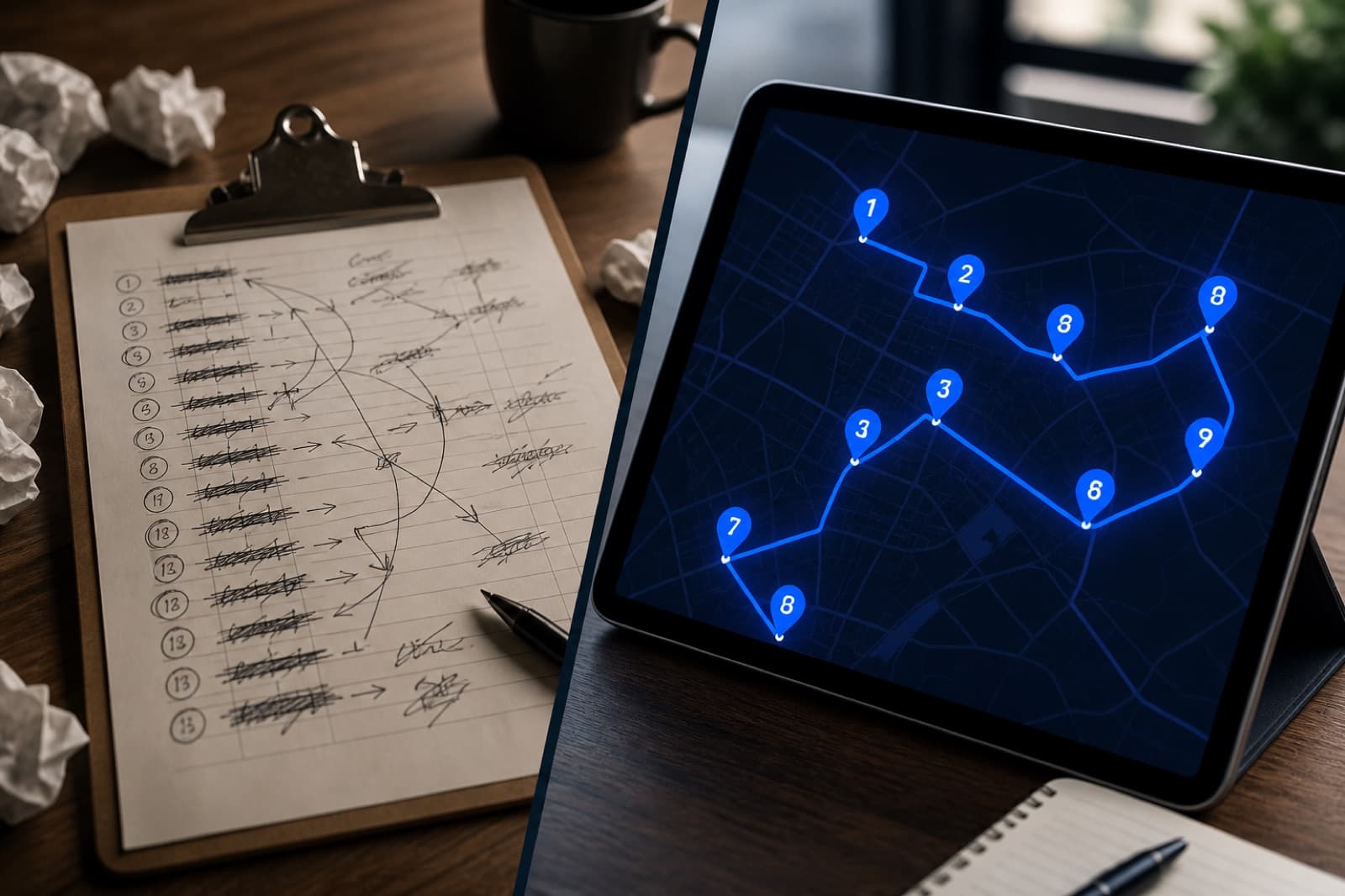
Route optimization sounds like a no-brainer — let the algorithm figure out the best order so you don't have to. And for many situations, it is exactly that. But optimization has real limits, and knowing when to use it versus when to override it makes you a smarter route planner.
What optimization actually does
When you hit Optimize in Free Route Planner, the tool finds the stop order that minimizes total driving time or distance across your entire route. It looks at real road geometry, not straight-line distances, and tests many possible orderings before returning the best one it finds.
What it doesn't know:
- Which stops have appointment windows
- Where parking is a nightmare
- That the business at stop 7 doesn't open until 10 AM
- That you know a shortcut the algorithm doesn't
When optimization clearly wins
6+ stops with no constraints: If you have a pile of errands and no time windows, an optimizer will almost always find a better order than intuition. The human brain is surprisingly bad at spatial sequencing when there are more than 5–6 locations in play.
Geographically spread stops: When your stops are scattered across a large area, it's very easy to plan a route that zigzags back and forth. The optimizer sees the whole picture and avoids backtracking.
Delivery routes you run regularly: Even a small improvement — 10 minutes per day — adds up significantly over weeks and months. Optimizing a regular route once and then re-optimizing when it changes pays for itself quickly.
Unfamiliar areas: In a city you don't know well, you have no intuition to rely on. Let the optimizer make the call.
When manual planning beats the algorithm
Hard time windows: If stop A must happen before 9 AM and stop B not until 2 PM, the optimizer may not handle this well unless it supports time constraints. When time windows are rigid, manually place time-sensitive stops first and let optimization handle the flexible ones.
Parking-dependent stops: Parking in downtown areas, hospitals, or airports requires local knowledge. If you know that stop 5 requires a 10-minute walk from the nearest garage and stop 6 has a dedicated loading zone, manual reordering may produce a better real-world route even if it looks worse on paper.
Local knowledge advantages: You might know that a certain road is under construction, a school zone slows things down at 3 PM, or that two stops share a parking lot. Algorithms don't know these things.
Small numbers of stops: With 3–4 stops, there are only 6–24 possible orderings. Optimization provides minimal benefit, and a quick mental scan usually works fine.
The hybrid approach: optimize, then adjust
The best workflow for most people:
- Add all your stops to Free Route Planner
- Run the optimizer to get a baseline route
- Review the map — does the sequence make sense visually?
- Manually adjust 1–3 stops where you have contextual knowledge
- Leave the rest as-is
This gives you most of the algorithmic benefit while letting you apply local intelligence where it matters.
A concrete example
Say you have 10 stops:
- Stop 3 must be before noon (a business that closes at 12:30)
- Stop 7 has terrible parking — you know to approach it from the south side
- Stop 10 is near your lunch spot and you'd like to end nearby
The optimizer might sequence these logically from a time/distance perspective but miss all three real-world constraints. Your move: let it optimize, then manually bump stop 3 earlier in the sequence, reorder stop 7 to follow a different nearby stop with better approach geometry, and ensure stop 10 is last (or near last).
Does the optimized route always save time?
Not always — and by a measurable amount. Research on human route planning vs. algorithmic optimization shows:
- For 5 or fewer stops, humans often match or beat simple algorithms
- For 10+ stops, algorithms typically outperform human intuition by 10–30%
- For 20+ stops, algorithms are almost always significantly better
The crossover point where optimization provides clear value is around 6–8 stops for most people. Below that, the gains rarely justify the time spent entering stops into a planner.
When to re-optimize mid-route
Plans change. A stop is closed. A new delivery gets added. Traffic adds 20 minutes to a segment.
When the real world diverges from your plan:
- Remove completed stops
- Add or remove changed stops
- Re-run the optimizer on remaining stops
Spending 2 minutes re-optimizing when your route has changed by 3+ stops can easily save 15–20 minutes of driving.
The bottom line
Route optimization is a powerful tool, not a magic black box. Use it as the foundation for your route planning, then apply your own judgment on top of it.
Free Route Planner makes it easy to do both — optimize automatically and then drag stops into your preferred order before you hit the road.